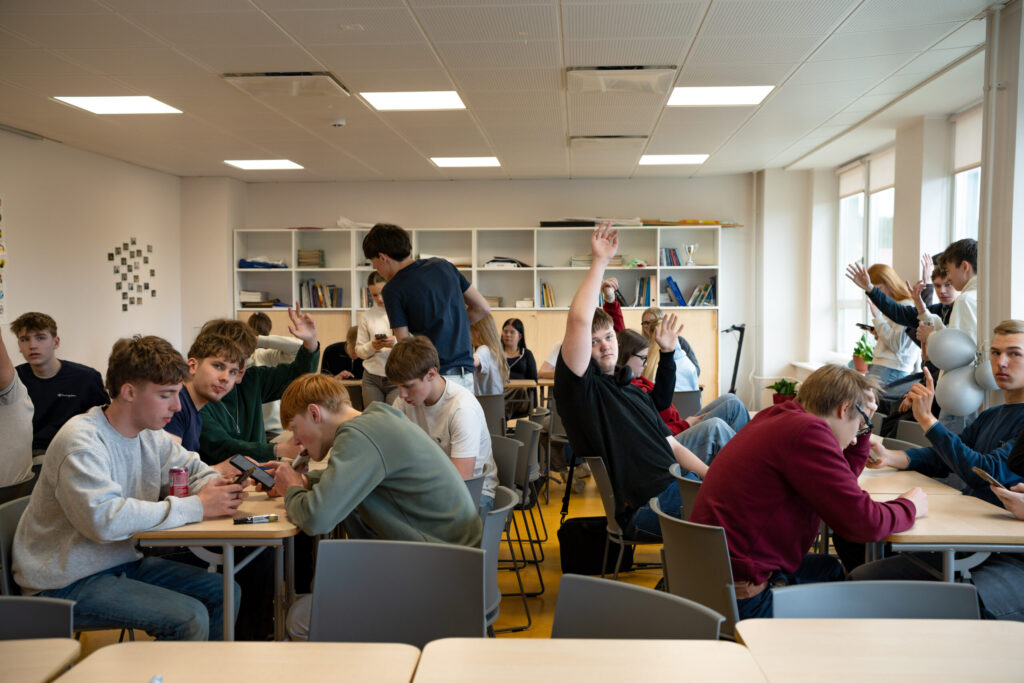
Discussions with approximately one thousand Estonian upper-secondary students showed that schools need clear agreements on the use of AI in learning. A lack of clarity is the students’ biggest concern: they often do not know when AI is permitted, when it is not, or what their teachers expect of them when they use it.
Between March and May, 950 upper-secondary students took part in World Café discussions at 18 schools across Estonia, exploring the role of AI in schools and its impact on learning, relationships, creativity, social media use, and their outlook on the future. The World Café discussions were organized by the AI Leap education program in collaboration with the Estonian School Student Councils’ Union (ESCU) and the Estonian National Youth Council (ENL).
“We often talk about how AI affects learning, but far less about how it affects education as a whole: young people’s relationships and creativity, and even how they envision their future,” said Mihkel Mariusz Jezierski, Student Program Lead at AI Leap. “School is not only a place where knowledge is acquired, but also an environment where young people develop as human beings. The role of AI must therefore be assessed more broadly than through learning outcomes alone, and this is precisely what we sought to bring into the public discussion together with students.”
According to the students, practices concerning the use of AI vary widely between both schools and individual teachers. Some teachers prohibit its use entirely, while others actively encourage it. Some students have seen teachers use AI to create teaching materials while prohibiting students from using the same tool.
The students feel that this lack of clarity also creates unfairness in assessment. They described situations in which work they completed independently received a lower grade than work produced with the help of AI because teachers found it difficult to distinguish the student’s contribution from that of AI.
Creative work is subject to similar uncertainty. According to a pulse survey conducted as part of the World Café discussions, only 21% of the students who responded feel that work created with the help of AI is truly their own. A total of 579 students responded to the survey.
Many upper-secondary students want clear guidance on how to use AI in creative work in ways that support the development of their own ideas without replacing the creative process or becoming the source of the ideas itself. They also need guidance on how to describe and acknowledge the contribution of AI in their work.
The students therefore want to work with their teachers to develop agreements defining when, how, and to what extent AI may be used in learning.
A Lack of Belonging May Encourage the Misuse of AI
AI offers immediate, nonjudgmental responses, making it easier for many students to turn to AI than to a teacher, parent, or peer, particularly in situations where they are afraid of making mistakes. According to the pulse survey, approximately one third of the students who responded turn to AI first for help, although around one in five rarely or never do so.
According to the students, the misuse of AI chatbots is more common among peers experiencing mental health challenges or difficulties with social interaction. The weaker a young person’s emotional support network and sense of belonging become, the more likely they are to replace human interaction with AI.
At the same time, upper-secondary students emphasize that AI should not—and cannot—replace humans as interaction partners. They see strengthening the social role of schools as part of the solution: as AI makes learning increasingly individualized, schools should place greater emphasis on fostering communication and a sense of community, while also ensuring access to mental health support.
The World Café discussions also highlighted concerns about social media algorithms, which the students believe are increasingly shaping their worldview and the information they consume. Young people also feel uncertain about the future as AI transforms the labor market and the skills it requires. They want schools to place greater emphasis on media literacy, the fundamentals of how algorithms work, and the skills needed to adapt to a rapidly changing world.
“Public discussions too often speak on behalf of young people without involving them directly. As a result, the solutions may not meet young people’s needs, or the problems may be approached from the wrong angle,” said Petrik Saks, Advocacy Specialist at the Estonian National Youth Council. “It is therefore essential that young people’s views and expectations remain at the heart of AI Leap’s work on issues concerning AI and education.”
According to Jezierski, one of the goals of the AI Leap education program for the next academic year is to help teachers and students at every Estonian school develop shared agreements on the use of AI.
Students’ Main Expectations for Schools
- Clear agreements developed jointly by teachers and students, defining when, how, and to what extent AI may be used in learning.
- A school culture that values making mistakes and learning from them, including in the age of AI.
- Access to high-quality mental health support and individualized feedback that supports learning, strengthens students’ sense of belonging, and helps prevent the misuse of AI.
- Transparency around the use of AI in learning, including clear labeling of AI-generated content.
Read the summary (in English) of the World Café discussions by AI Leap, the Estonian School Student Councils’ Union, and the Estonian National Youth Council.