
AI Leap Learning Application

ITI – AI designed to support learning

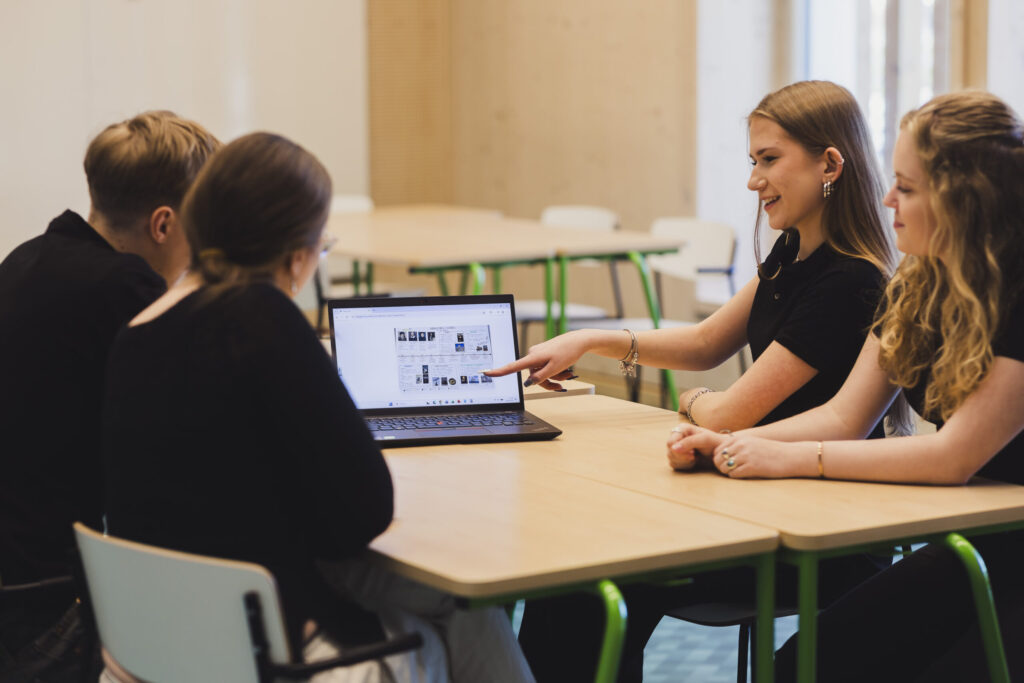
ITI is an AI learning app for Estonian students, developed with OpenAI and Estonian researchers. Built on ChatGPT, it offers explanations, questions, and feedback to support learning. Students remain responsible for working through problems and developing their own understanding.

ITI is available to upper secondary and vocational upper secondary students at Estonian schools participating in AI Leap.

Understand the topic "Can you explain this with a different example?”
Practice for a test “Give me a similar problem to solve on my own.”

How the learning app supports learning

The learning app is designed to encourage students to reason for themselves, draw on prior knowledge, and work with information in manageable amounts.

Understand a topic

Ask for explanations and examples, then describe what you understand in your own words.

Example prompt

“Can you explain this with a different example?”

Practice and review

Try solving a problem yourself, ask for feedback, and review any mistakes.

Example prompt

“Can you help me identify where my reasoning went wrong?”

Plan and reflect

Break an assignment into smaller steps and check your understanding as you go.

Example prompt

“Ask me three questions to check my understanding of this topic.”

Developed with technology partners and researchers

AI Leap works with technology partners and researchers to adapt AI tools to educational needs. Development combines pedagogical design, technical implementation, and ongoing evaluation.

  • Technology partnerships

    AI Leap works with OpenAI and Google. The ChatGPT-based learning app is developed in collaboration with OpenAI.

  • Learning science

    Estonian researchers and educational psychologists contribute to the learning app’s design and evaluate how its responses support learning.

  • Language and context

    The Institute of the Estonian Language helps adapt the learning app to Estonia’s language and culture, supporting students’ motivation, persistence, and language skills.

Criteria for development and evaluation

The learning app is evaluated against 19 behavioral criteria developed by Estonian researchers and educational psychologists under the leadership of Professor Jaan Aru. The criteria describe intended behavior and guide ongoing improvements. Selected examples are shown below.

The AI helped the student plan how to solve a problem.

It helped the student recognize a mistake or misunderstanding.

It explored the student’s thinking by asking for explanations.

It conveyed that mistakes, confusion, and difficulty are part of learning.

It encouraged the student to identify a new context for a phenomenon or solution.

It offered an opportunity to practice applying a solution in a new context.

It follows Estonian communication norms and uses correct Estonian.

Its responses are an appropriate length and do not overload working memory.

Its responses are consistent with currently accepted interpretations in Estonian society concerning history, geopolitics, minorities, gender, and related topics.

Its responses are logical, relevant, and free of substantive errors.

Use and research

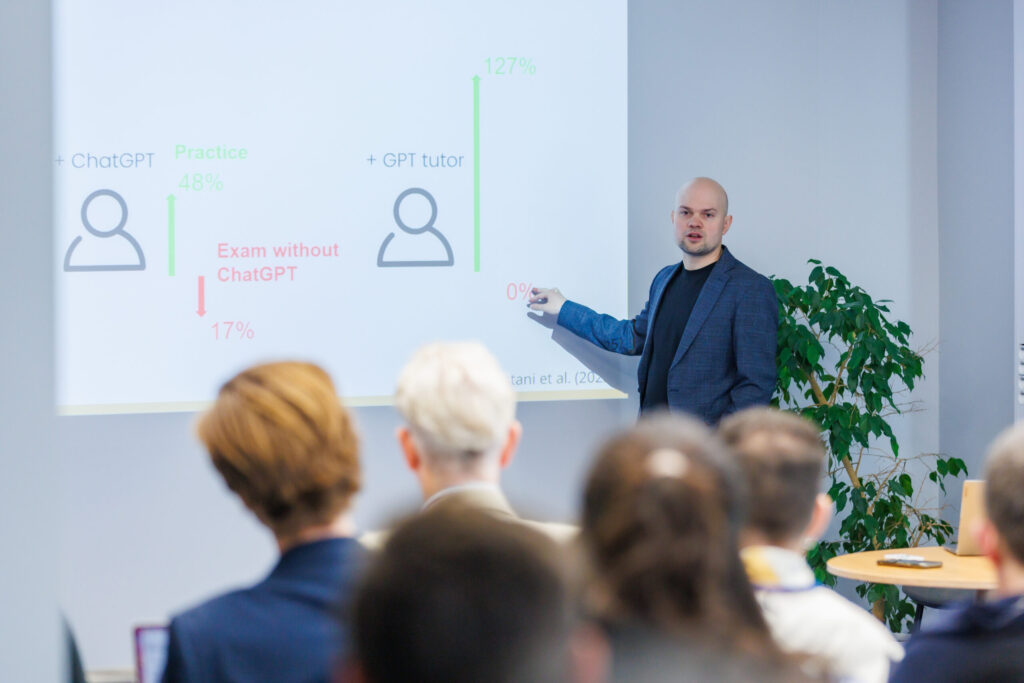
Usage data describes how students engage with the learning app. Research explores its effects on motivation, perseverance, self-regulation, learning strategies, and AI literacy. Usage figures alone do not show whether the app improves learning.

Read more about the research

12,400+

Student accounts activated for the ChatGPT-based learning app by May 26, 2026. Figures will be updated in October 2026 after new student cohorts join.

9,000+

Students participating in the University of Tartu–led longitudinal study.

100

Schools participating in the study.

Student feedback

Selected student feedback from AI Leap’s 2025–26 annual review. Translated from Estonian.

"AI helped me learn many topics in math, physics, and chemistry this year. It explains things well and is a useful learning companion—you just need to know how to use it."

Student at Jakob Westholm Gymnasium

"I really like how you’ve designed it. It doesn’t hand you the answers. It’s like a teaching assistant. Once you get used to it, it can be very useful."

Student

Part of a nationwide approach to AI in education

AI Leap is Estonia’s nationwide education program, supporting schools as they adapt teaching and learning to the age of AI. The learning app is one part of a broader approach.

  • Teacher development

    Training and professional learning communities help teachers examine and develop their teaching practices.

  • Student AI literacy

    Workshops and practical activities help students understand AI, its limitations, and responsible use.

  • Learning-focused technology

    Access to AI tools is accompanied by support, evaluation, and continued development.

FAQ

For questions about the program or research, contact the AI Leap team at info@tihupe.ee.

The learning app is built on ChatGPT and adapted to support learning. It is designed to offer questions, hints, and feedback that encourage students to work through problems themselves. Its development and evaluation follow pedagogical criteria created by Estonian researchers and educational psychologists.

The learning app is available free of charge to upper secondary and vocational upper secondary students at participating schools in Estonia. Organizations outside Estonia can contact the AI Leap team to learn about the program and discuss potential collaboration.

A University of Tartu–led longitudinal study involves more than 9,000 students across 100 schools. It examines learning motivation, perseverance, self-regulation, learning strategies, and AI literacy. Usage data and student feedback also inform development; they do not, on their own, establish an impact on learning.

Teachers decide how the learning app fits their teaching and when its use is appropriate. It provides additional support for students alongside classroom instruction. AI Leap also offers teacher training and professional learning communities to help schools develop their practices.