
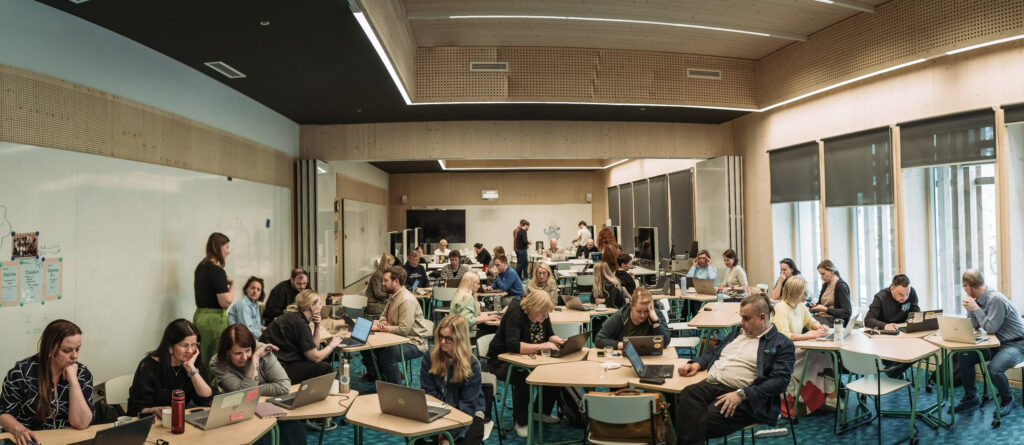
In July, a report on a study of teachers who participated in the AI Leap program was completed. Its findings show that, in the age of AI, collaborative learning among teachers is not merely an additional opportunity but a prerequisite for meaningful change. If we want schools to support learning rather than merely performance, we must give teachers time and create a safe space for them to think, experiment, and learn together, writes Piret Oppi, Program Manager at AI Leap.
AI entered schools before school communities had the chance to discuss what it means for teaching and learning. A study conducted in Estonia in early 2024 found that 90% of high school students had used AI for learning (Granström and Oppi, 2025a). Ten months later, however, 47% of teachers said they had never used AI in their work (Granström and Oppi, 2025b). In other words, students had made the AI leap several years earlier.
The picture has since changed. Nearly 800 teachers participated in the spring survey of teachers in the AI Leap program, and 95% of them had begun using AI in their work. Most used ChatGPT, and one-third also used Gemini. It may therefore seem that teachers are quickly catching up with their students.
Frequency of use, however, is not the same as pedagogical readiness. Knowing how to write a prompt in a chat window is not enough. Teachers need to understand what AI is, how it works, what its opportunities and limitations are, and how to use it in ways that support learning. Most importantly, we need to ask again: What do teaching and learning mean in the age of AI?
AI Reveals Whether We Support Learning or Performance
When every student has an intelligent assistant in their pocket, ready to write a text, solve a task, or suggest an idea on their behalf, we cannot continue relying on the same pedagogical approaches that have worked until now. AI holds up a painful funhouse mirror: all too often, instruction primarily supports performance rather than deep learning. AI is excellent at producing a polished final result, but in doing so it may also take over the thinking that the learner needs to do in order to learn.
If we assess only whether a student arrived at the correct answer, we may not know whether they understood the problem, considered different solutions, checked their sources, noticed errors, or could justify their choices. Learning must therefore become more visible. In addition to the answer, we need to see the path that led to it—the student’s questions, interim decisions, reasoning, doubts, and revisions.
This requires broader changes to assignments, feedback, and assessment. It makes little sense to leave these changes as private experiments for individual teachers, because they affect the entire school’s understanding of what good learning looks like. This is precisely why collective reflection among teachers becomes essential in the age of AI.
Participation in Professional Learning Communities Is Associated With Real Change
In the AI Leap program, we deliberately chose a more demanding but sustainable path. Alongside individual training sessions on specific tools, we supported the development of collaborative teacher learning in schools through professional learning communities (PLCs). These PLCs gave teachers regular opportunities to meet, learn together, and discuss what to do when everyone has an intelligent helper—or a kratt, the magical servant of Estonian folklore—in their pocket, ready to do much of the work for them.
The spring survey found that PLCs had been established in two-thirds of schools. Compared with teachers who did not participate, those who took part were more likely to have reconsidered which skills students need in the age of AI. They had more often changed homework assignments, guided students in using AI applications, and redesigned both their approaches to feedback and their assessment systems.
PLCs offer another important benefit. Compared with their colleagues, participating teachers were more motivated to learn collaboratively and saw greater value in doing so. They perceived the time commitment and stress associated with participation as lower, were more confident that learning together would improve the quality and effectiveness of their work, and found the learning experience more enjoyable.
This is an important insight for school leaders: time devoted to collaboration is an investment in the quality of teaching. Well-organized collaborative learning reduces the burden of experimenting alone and gives teachers the support of colleagues when addressing difficult questions.
A Culture of Collaboration Cannot Be Created by Decree
At the same time, a collaborative school culture does not emerge simply because a meeting is added to the calendar and called a PLC. To learn together in a meaningful way, teachers need genuine time, a clear purpose, and a safe space. In such a space, they can share unfinished ideas and unsuccessful experiments, ask for help, give honest and constructive feedback, and work together to determine how the latest knowledge can be applied in ways that support student learning.
A learning school is not only one in which students learn. Teachers, school leaders, and other members of the school community must also see themselves as learners. Learning together, experimenting, making mistakes, discussing them, and trying again must become the norm at school.
We have normalized the effort that learning requires for students. We must do the same for adults, including teachers. Professional learning for teachers does not need to be quick or easy. Much of what we have learned about teaching and learning in recent years requires time and sustained attention before it can become effective classroom practice. School leaders should therefore create favorable conditions for teacher learning: protected time within working hours, consistent leadership, and a shared agreement that collaborative learning is real work, not an additional obligation.
It is an achievement that PLCs have already been established in two-thirds of schools, but the remaining third shows that these conditions do not yet exist everywhere. The next step is to make collaborative teacher learning a natural part of everyday work in every school.
Never Alone Again
In a time of rapid change, no teacher should have to figure out alone how to respond to AI as a new challenge in education. Let us come together, think together, learn together, and find and share effective solutions. AI is not a matter only for computer science teachers or educational technologists. Supporting students’ digital competence and AI literacy is a shared responsibility across the entire school. Learning together helps us understand how every teacher can support digital competence and AI literacy in their own subject. After all, these are all our children.
Our task is to support the development of their knowledge, skills, and attitudes so that the next generation is wiser than the one before it—not simply faster at producing answers. If we want our children to learn to think for themselves in the age of AI, we must first learn together.
- For an overview of the program’s first year, read the AI Leap First-Year Report.