
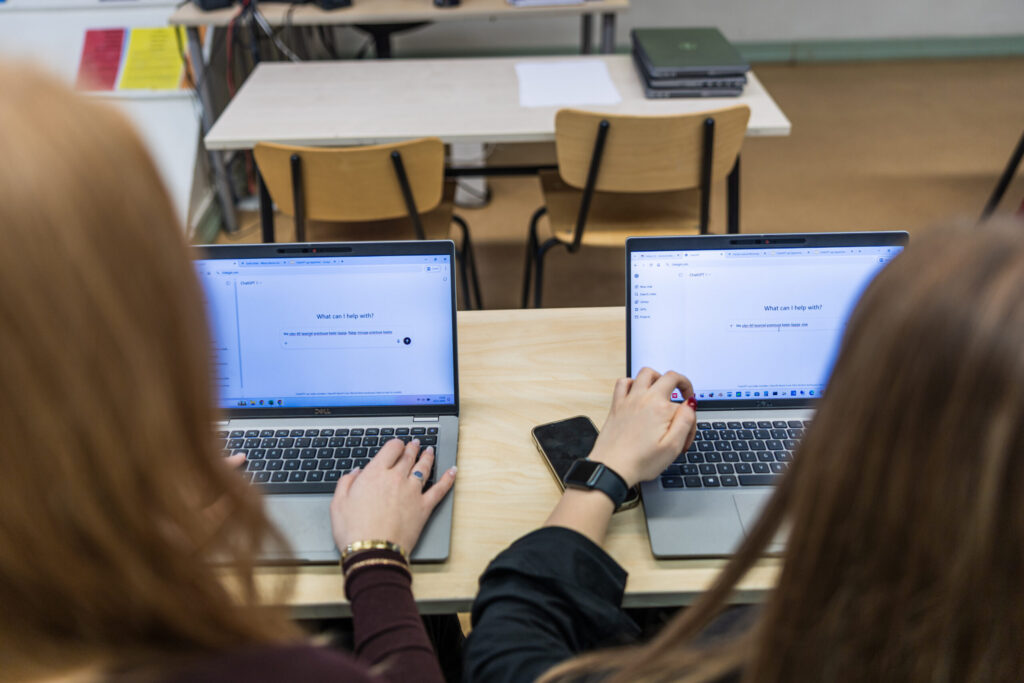
This week, the AI Leap Foundation began creating user accounts for approximately 20,000 10th–11th grade students in 154 upper secondary schools that have joined the AI Leap education program.
The application is a ChatGPT-based model developed specifically for Estonian students in collaboration between Estonian researchers and OpenAI. Unlike a standard large language model that simply provides answers, this version is designed to support learning. The model continues to be refined in ongoing collaboration with researchers and technology companies.
AI Leap has now reached nearly all Estonian upper secondary schools: 154 schools and approximately 4,800 teachers have joined the program. Teachers were granted access to ChatGPT and Google Gemini premium versions already in August 2025, and a dedicated support program has been launched to strengthen teachers’ AI literacy and help integrate AI into classroom instruction.
In early January, a law was passed granting schools the legal authority to implement AI applications. The AI Leap Foundation began signing license agreements with participating schools. By this week, agreements had been signed with approximately half of the schools, and the number continues to grow daily. Schools provide the Foundation with students’ email addresses, through which student accounts are created. Students receive their login credentials via email.
For students, the learning application resembles standard ChatGPT in appearance, but it behaves differently. The application is built on 19 behavioral criteria developed by Estonian education psychologists and researchers under the leadership of professor Jaan Aru. For example, it provides tasks tailored to the student’s level, helps identify mistakes, supports planning effective study strategies, and guides students to seek answers independently from learning materials and formulate their own conclusions.
The application communicates in Estonian, though further development is still needed particularly in handling Estonian language nuances and cultural context. To address this, ongoing collaboration with researchers from the Institute of the Estonian Language ensures that the application’s language use and communication style align with expectations rooted in Estonia’s linguistic and cultural environment.
How and how often the application is used remains at the discretion of students and teachers.
“The goal of AI Leap is not to encourage students to use AI more than they already do, but to provide a learning-supportive alternative to widely used free AI models that can undermine critical thinking and the development of learning skills,” said Ivo Visak, CEO of AI Leap.
According to Visak, it is encouraging that teachers have found time alongside their significant workloads to engage with AI topics and adapt to change. Teachers have already used AI creatively—for example, to tailor learning materials to different ability levels, reduce administrative workload, and in the classroom itself, such as serving as a foreign-language conversation partner.
“The learning application does not replace existing methods of learning, but we encourage students to experiment with the new tool in their studies and share their experiences,” Visak added. Both critical and positive feedback are welcome and can be submitted through the website tikogemus.ee, helping the Foundation identify ways to further improve the application’s support for learners.
AI Leap is implemented as a public–private partnership. The Ministry of Education and Research covers half of the pilot year’s funding, with the remainder provided by private companies and individual supporters. Early lead partners include Telia, Skaala, and the Smart Future Foundation, along with several private individuals.
Launched by President Alar Karis last year, the AI Leap educational programme aims to help secondary school students develop stronger learning habits and to support teachers in adopting new tools. It has been introduced in almost all of the upper secondary schools in Estonia. The AI Leap app is being made available to students in the 10th and 11th grades. Around 20,000 learners and 4800 teachers from 154 schools have joined the programme.